
Sitharaman also listed out various welfare schemes like affordable housing, direct benefit transfer and Ayushman Bharat.

The RBI interest rate decision, industrial production data for June and the ongoing quarterly earnings from corporates would largely drive the stock markets this week, analysts said. Other major factors such as global market trends, the movement of oil prices and the trading activity of foreign investors would also influence trading, they added. "The market will have an eye on the RBI Monetary Policy Committee (MPC) meeting, which will be announced on August 10, 2023. We are heading towards the last batch of Q2 earnings of key companies such as Adani Ports, Coal India, Hero MotoCorp, Hindalco and ONGC, among others, which will lead to stock-specific movement," said Pravesh Gour, senior technical analyst, Swastika Investmart Ltd.

Maximum cases of advertisement norms violations were reported from the healthcare sector during 2023-24, followed by illegal offshore betting and personal care categories, according to the Advertising Standards Council of India's (Asci's) Annual Complaints Report released on Wednesday. The healthcare sector accounted for a maximum 19 per cent or 1,569 of 8,229 advertisements scrutinised by Asci during the year. Illegal offshore betting accounted for 17 per cent, while the share of personal care advertisements was 13 per cent.

Do not keep a large portion of your long-term portfolio in FDs.

Retail investors now own a larger share of smallcap companies than they did a year ago, thanks to their conviction in mutual fund (MF) schemes focused on this segment. Data from Capitaline shows that MFs' average holding in the National Stock Exchange Nifty Smallcap 250 Index stood at 9 per cent at the end of the October-December quarter of 2023-24 (FY24), up from 7.76 per cent in the same quarter of 2022-23.

The central government's fiscal deficit touched 21.2 per cent of the annual target in the June quarter as against 18.2 per cent in the year-ago period, according to official data. The fiscal deficit is the difference between total expenditure and revenue of the government. It indicates the total borrowing that are needed by the government.

Polarisation in the performance of Indian banks will persist as many large public sector banks are still saddled with weak assets, high credit costs, and poor earnings, S&P Global Ratings said on Thursday. It said State Bank of India and leading private sector banks have largely addressed their asset quality challenges, and their profitability is improving more sharply than the banking system. In its Global Banking Outlook-2023 report, S&P said economic recovery is driving credit costs to cyclical low levels and stronger balance sheets and higher demand should boost bank loan growth, but deposit growth will lag.

Retirement fund body EPFO fixed 8.15 per cent rate of interest on employees' provident fund (EPF) deposits for 2022-23 at its meeting on Tuesday. In March 2022, EPFO had lowered the interest on EPF for 2021-22 to an over four-decade low of 8.1 per cent for its about five crore subscribers, from 8.5 per cent in 2020-21. This was the lowest since 1977-78, when the EPF interest rate stood at 8 per cent.

The regulatory gap between crypto firms registered with the Financial Intelligence Unit-India (FIU-India) and unregistered offshore entities is expected to narrow, industry players said, after global crypto players Binance and KuCoin received approvals to register with India's anti-money laundering unit.

Ask rediffGURU and PF expert Nitin Narkhede your mutual fund and personal finance-related questions.

The country's largest insurer LIC is the fifth most valuable company in the country with a market capitalisation of about Rs 5.54 lakh crore. Life Insurance Corporation (LIC) made a tepid stock market debut on Tuesday following a mega IPO which fetched Rs 20,557 crore to the exchequer. The shares listed on stock exchanges at over 8 per cent discount over its issue price of Rs 949 apiece.

96 per cent is being collected through TDS, advance tax, self-assessment tax, and other receipts.

The total benefits paid by private life insurance companies to policyholders rose by 5.98 per cent to Rs 1.57 trillion during 2022-23. This figure stood at Rs 1.49 trillion in the corresponding year-ago period. On the other hand, Life Insurance Corporation of India (LIC) paid out 4 per cent fewer benefits at Rs 3.39 trillion from Rs 3.53 trillion in 2021-22.

India's internet economy is estimated to reach $1 trillion by 2030, primarily due to e-commerce, which is expected to be worth $325 billion and rank third globally, according to industry experts. Last year marked a crucial turning point for India's e-commerce sector, with notable changes in consumer trends, technology, and regulations. InGovern Research Services, a leading corporate governance advisory firm, hosted a virtual roundtable to deliberate on the notable developments in India's e-commerce sector in 2023, with a particular focus on the essential role of customer trust in fueling its ongoing expansion.

The 'Khela Hobe' slogan will reverberate across India in the coming days, said Trinamool Congress MLA Madan Mitra on Saturday.

The deepening funding winter that the startups face and the near dry-up of IPOs singed the deal street as the total value of deals plunged by 60 per cent to $1.8 billion in February, shows an analysis. According to Grant Thornton, the industry saw just 89 deals worth $1.8 billion in February, which is 60 per cent lower than the year ago period in value terms and down by 54 per cent year-on-year in volume as investors continued to tread cautiously amid macroeconomic uncertainties. This is the second-lowest deal volume and the lowest value since 2014.
Benchmark indices gained for the third day running on Friday, with the Sensex climbing over 300 points amid mixed global market trends. The 30-share BSE benchmark advanced 303.38 points or 0.56 per cent to settle at 54,481.84. During the day, it jumped 448.68 points or 0.82 per cent to 54,627.14. The broader NSE Nifty went higher by 87.70 points or 0.54 per cent to end at 16,220.60.

Domestic quarterly earnings, global trends and foreign fund trading activity would dictate the movement in equity markets, which may face volatility amid the scheduled monthly derivatives expiry this week, analysts said. Equity markets took a breather last week. The BSE Sensex declined 298.22 points or 0.48 per cent and the Nifty dipped 111.4 points or 0.60 per cent.

Investors' wealth plunged over Rs 3.91 lakh crore on Friday amid an extremely weak broader market trend. The BSE benchmark tanked 773.11 points or 1.31 per cent to settle at 58,152.92 after a weak opening. During the day, it tumbled 1,011.93 points to 57,914.10.

The post-Covid pandemic boom in corporate revenues appeared to have faded away in 2023-24. Yet, companies have reported a sharp recovery in their profits in FY24, driven by high margins. Their combined net sales, including gross interest income for lenders, rose by a modest 4.8 per cent year-on-year (Y-o-Y) in FY24.
The market capitalisation of BSE-listed firms jumped to an all-time high of Rs 304.53 lakh crore on Wednesday, buoyed by an unprecedented rally in equities where the BSE benchmark Sensex ended over the 67,000-mark for the first time ever. Rallying for the fifth day running, the 30-share BSE Sensex climbed 302.30 points, or 0.45 per cent, to end at its lifetime closing high of 67,097.44 points. During the day, it jumped 376.24 points, or 0.56 per cent, to reach its all-time intra-day peak of 67,171.38 points.

At a time when the tech sector witnessed a spree of layoffs and slowdown in new hiring, IT firms have opted for temporary jobs in order to turn some their fixed costs variable. Work fulfillment platform Awign has reported a 157 per cent rise in demand for such jobs in first half of 2023. Awign says most of the demand has arisen for highly-skilled tech professionals at mid-level and senior positions with 2-7 years' experience.

'We expect market consolidation and recommend buying during market dips.'
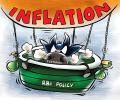
Amid a debate on the basis of a monetary policy stance, one may be curious enough to know how non-food retail inflation has behaved over the years in India. Let the eager souls catch a glimpse of facts. In the past 10 years, non-food inflation came down below 4 per cent on two occasions - pre-Covid period of 2019-20 and now in the first four months of the current financial year (FY25).

Financial services and consumer durable companies accounted for most of the selling by foreign portfolio investors (FPI) in the last fortnight of February. FPIs sold finance stocks worth Rs 2,263 crore and consumer durable stocks worth Rs 1,111 crore, according to data collated by Prime Infobase. Information technology (selling worth Rs 708 crore), metals and mining (Rs 694 crore), and power (Rs 497 crore) were the other sectors where overseas funds sold shares.

The global billionaires list witnessed as many as 94 new entrants from India, stated a report by Hurun India on Tuesday. Following a net addition of 84, the country's billionaire tally touched 271 with their combined wealth at $1 trillion, noted the report. Mukesh Ambani, chairman & managing director of Reliance Industries, is the only Indian to make it into the top 10 of the Hurun Global Rich List 2024, a ranking of billionaires in US dollar terms.

Ask rediffGURU and PF and MF expert Janak Patel your mutual fund and personal finance-related questions.
Equity markets would be mainly driven by global trends and foreign fund trading activity in the holiday-shortened week, analysts said. The BSE and the National Stock Exchange have listed March 7 (Tuesday) as a holiday on account of Holi. However, stock brokers' association ANMI has urged the government, exchanges and Sebi to shift the holiday to March 8 from March 7.

With digital adoption fast gaining currency, India is likely to see retail digital payments double to $7 trillion by 2030 from current levels, a study by Kearney and Amazon Pay said. In the report 'How Urban India Pays', Kearney-Amazon Pay said strong adoption of digital payments in online purchases has potentially led to a permanent shift in consumer behaviours, fuelling offline adoption as well.

Benchmark indices managed to settle in the positive territory on Friday, with the Sensex climbing over 59 points, as fag-end volatility trimmed most of the day's gains. A largely firm trend in global markets and foreign fund inflows propped up the bourses, traders said. The BSE Sensex climbed 59.15 points or 0.10 per cent to settle at 58,833.87.

Banks submitted bids amounting to Rs 4.75 trillion, around 2.5 times of the notified amount of Rs 1.75 trillion, at the Variable Rate Reverse Repo (VRR) auction conducted by the Reserve Bank of India (RBI) on December 22, a day after the liquidity deficit in the banking system widened to Rs 2.5 trillion. In the most recent VRR auction held by the RBI on December 15, bids totaling 2.7 times the notified amount were received. Banks secured Rs 1 trillion at a weighted average rate of 6.63 per cent.

The accused has been apprehended, a senior police officer said.

Love as illustrated by a Rediff.com's cartoonist Uttam Ghosh...

The tailwind of low price erosion in the US generics market, seen by domestic pharmaceutical companies in calendar year 2023 (CY23), may be reversing slowly, caution analysts. According to the latest data from US-based Centers for Medicare and Medicaid Services (CMMS), price erosion in calendar year 2024 (CY24) on a year-to-date (YTD) basis stood at a high of 15 per cent in the oral solid dosage (OSD) segment compared to a low of 1 per cent in CY23. This erosion, according to a report by Antique Stock Broking, was the highest in the last three years.

Average housing prices have increased in the range of 13-33 per cent in the last three years across seven major cities on high demand, according to real estate consultant Anarock. Hyderabad's Gachibowli recorded the highest 33 per cent increase in average residential prices in the past three years. In Gachibowli, the average residential prices as of October 2023-end stood at Rs 6,355 per square feet as against Rs 4,790 per square feet in October 2020.

Alternative Investment Funds (AIFs) with a lock-in period performed better than the ones that allow investors to withdraw capital at any time. Close-ended schemes had a median return of 5.62 per cent in December, according to data from industry tracker PMSBazaar. The median returns for open-ended schemes were 3.91 per cent

Jet fuel prices on Friday were hiked by 2 per cent - the seventh straight increase this year - to an all-time high, reflecting a surge in global energy prices. Aviation turbine fuel (ATF) - the fuel that helps aeroplanes fly - was hiked by Rs 2,258.54 per kilolitre, or 2 per cent, to Rs 1,12,924.83 per kl in the national capital, according to a price notification by state-owned fuel retailers. There was, however, no change in the price of petrol and diesel on Friday.

The country's six largest smallcap schemes would require more than 20 days to liquidate half of their holdings, despite most of them maintaining high cash levels and having considerable exposure to more liquid largecap stocks, stress tests conducted by fund houses reveal. For midcap funds, the time required to sell half of the assets of the top six schemes varies between seven and 34 days, according to disclosures made by asset management companies. The Securities and Exchange Board of India (Sebi) had called for such tests in the face of strong inflows into smallcap and midcap funds, despite concerns over high valuations, to keep investors better informed.

Alternative investment funds (AIFs) have not seen any significant redemptions from financial institutions even though the 30-day timeline provided by the Reserve Bank of India (RBI) to liquidate their holdings or make full provisions ends recently. Sources said the industry is awaiting certain relaxations or extensions based on the recommendations submitted to the banking regulator. On December 19, the RBI restricted financial institutions and banks from investing in AIFs where there is any downstream link or exposure to a debtor firm.

The Income Tax Department on Tuesday said software services provider Infosys has been directed to look into the issue relating to malfunction of search option on the e-filing portal. After many users complained of issues while accessing the I-T portal and reported that it was hacked on Tuesday, which also happens to be the first launch anniversary of the portal, the department said Infosys is resolving the issue on priority. "Issue relating to the search functionality of the e-filing website has come to our notice.
